Interview
Berlin
Verbally High-Fiving Each Other – In Conversation With Teun Verheij
Issue 01: Community & Network
49.99€
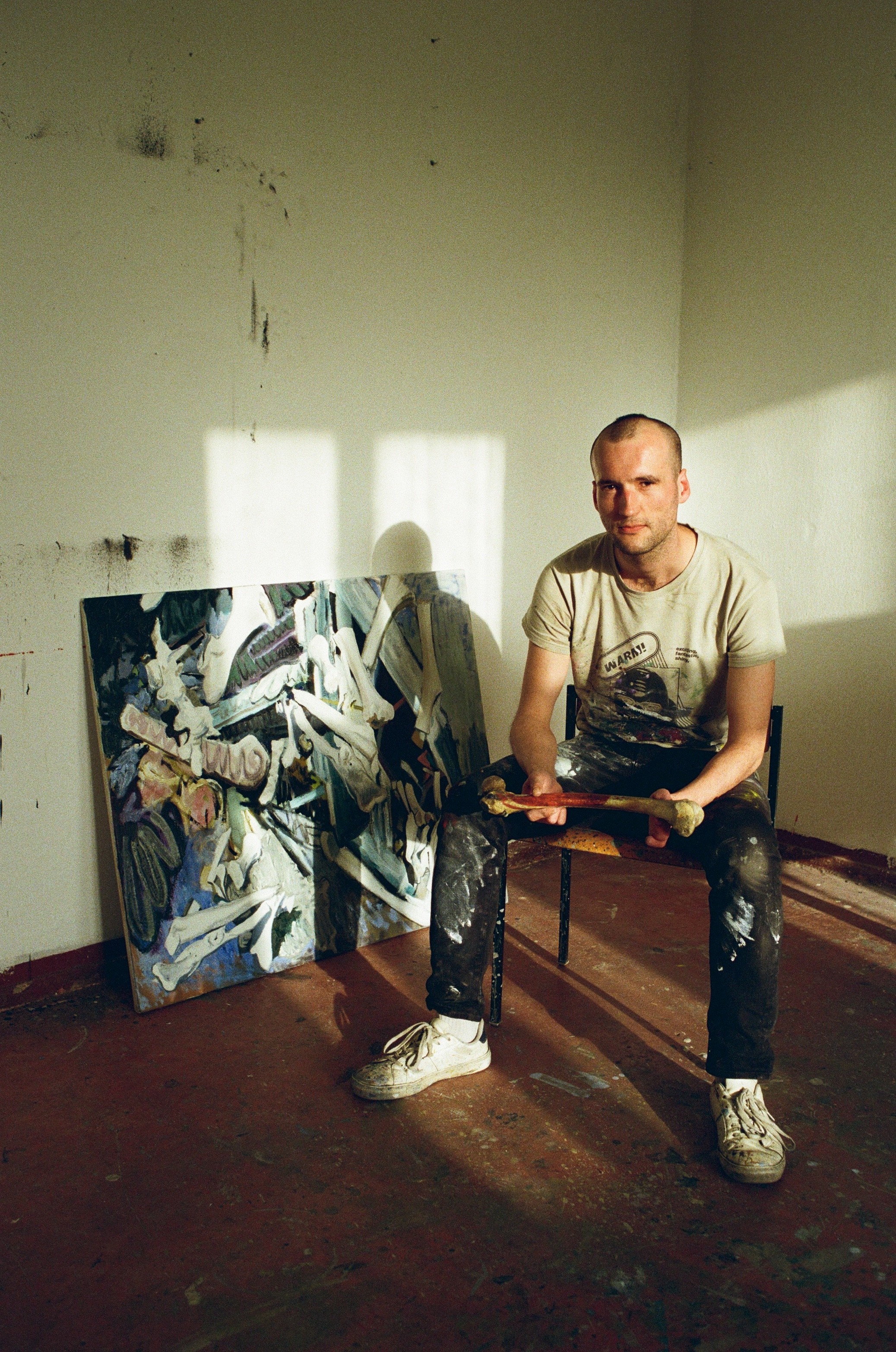
What makes an oeuvre? What makes it any good? Self-organisation, not waiting for an institution to give you an opportunity, and coming together: or so Teun Verheij (or so Lennon & McCartney?). Weaving through Leipzig some 10 years ago now, studying art, drumming in a punk band, and taking advantage of the city’s spirit, Teun is finding that sweet spot between his crush on Rembrandt and the desire to disrupt the current plague of “Zombie formalism” in art. Bringing this sentiment along with him to his current base, Berlin, Teun and I meet for a chat in his studio in Adlershof to talk about his recent solo show, Instagram for artists, and community building, among other things. What initially struck me about Teun was his demeanour: relaxed, flexible and open while equally high-strung and meticulous – a quality he shares with his paintings. He strikes a match, swiftly, raising the match to the cigarette dangling from his mouth, and begins to dish out on professors who pissed him off. In the same breath, he reflects on vulnerable moments of rejection and the self-reckoning he had to undergo to come out the other side as a reflected human being. The scribbles, horns and dismembered pieces of furniture that float in his compositions are intriguing, and dare I say: good. Despite the interview being our first IRL meeting, I decide to wear him down with banter, only to realise he’s beating me to the punch.
TV: I moved to Leipzig 10 years ago to study there. It's a bit of a long story.
I dropped out of art school back in 2012. After a short stay in Malta, I came back and found out I couldn't continue studying due to some bureaucratic reasons, so I just started looking for universities I could study at for free. I applied just about everywhere, and HGB Leipzig accepted me, so I moved there. I submitted a really bad portfolio, but I got lucky because there was a cow in one of the drawings in my portfolio, and it turned out to be the replacement teacher’s favourite animal. She loved cows. She was all about cows, and so she really liked this drawing. That goes to show how volatile these things are, right?
Teun was drawn to Berlin, particularly the UdK, even while living in Leipzig. He would take the train up to Berlin on the weekends, attempting to snag a meeting with a professor there or find a way to submit his portfolio. We discuss the fickle nature of these things, the Catholic guilt associated with hard work and diligence, and how the world might not come to you, despite all of your hard work.
TV: Do you remember that one club at the intersection of Karl-Marx-Allee and Prenzlauer Allee? They had a ball pit, you know, like, for children. I met this girl there, Lisa, who studied at the UdK at the time that I was trying to get in, and I had a meeting planned with a painter who taught there. The class representative told me, “We’ve made you an appointment, so we can see your portfolio.” The night before, I went to this club, and I saw Lisa. I'm like, “Oh, hey, I'm excited to show my portfolio tomorrow.” We're both in this ball pit, and she's like “... Oh yeah, no, by the way, we’re going on a class excursion tomorrow, also wird’s leider nichts.” That was gut-wrenching. I travelled to Berlin for this. I almost camped in the hallways of the UdK just to try and talk to people. That was my strategy: Show up.
This can be on tape, by the way: I think that HGB Leipzig fucking sucks.
MB: Got it. Underlined.
TV: I think these people are way up their own asses. You can print that. That movement of painters didn’t influence me (referencing the likes of Neo Rauch). I cringe when people call my work Leipziger Schule, but when I went back to Holland to do a show, I got a lot of comments claiming my work was copying that exact style. The truth is, I didn’t even know the works they were comparing my stuff to at the time. While I was studying in Leipzig, everybody was doing some form of smudgy abstraction or Op-Art. It was very different from that cliché.
Teun may share formal similarities with the ‘Leipziger Schule’, but he draws much more from American painters: Think Jim Shaw and David Salle.
TV: Otherwise, I had a really nice time in Leipzig. I played in punk bands there for seven years, and we were a part of that non-commercial, DIY circuit. Living in Leipzig led me to encounter subculture in such a unique way, like the way people were dealing with Leerstand (vacancy of buildings) there, was so unlike what I saw in Holland.
MB: How was it different living and working in Leipzig 10 years ago? I feel like everyone's been skipping Berlin for Leipzig recently, as though they had just clocked it was there.
TV: It was always there. When I went there in 2015, people were already saying it was all downhill from here. The coolest years had allegedly already passed.
MB: People say that all over the world about anything, about Berlin, like, “this is over, that is so over.” More often than not, it feels like a sweeping statement. I think we’ve still got a fighting chance.
TV: I agree. I don’t know if things are getting worse or even better, but there are definitely some old farts around claiming that their heyday was the best time to exist. That whole “You guys don’t know shit, you’ll never know how cool it was” thing? I try to stay very far away from that. I came to Berlin during the pandemic, an obvious low point, and I felt very happy about being here. I have no idea how Berlin was in the 90’s, and I’m not even sure I have the right to judge how cool a place is at all. I think it’s easy to claim something is “over” once you start being more close-minded. There are so many new things going on in Berlin, I mean, there is a flourishing queer community, and there are always new spaces opening up, but if you keep going to the same old places, you lose sight of that. But yeah, gentrification is real, and I’m not trying to deny that. But in terms of resistance to gentrification, I do still see things popping up left and right that are interesting.
Sitting together in Teun’s studio, he lights his first cigarette. I look around at the space. It’s no small studio, and he has the room all to himself. How did he garner this sweet deal?
TV: This is a BBK studio, and I pay something like €120 a month. It's pretty much for life, unless I start making a lot of money, but they check your income every two years and then every four years to make sure you’re still eligible.
We talk about shared studios, overpriced rent for said studios, and how competitive the market is. Back to his struggle to access the UdK, I wonder what pushed him to leave Leipzig after his studies? Was Leipzig a placeholder?
TV: I wanted to move to Berlin eventually, but I don't think like that. People shouldn't think like that. Distractions don’t exist, you’re not on a crusade or on some holy mission to achieve something.
I think that the pressure to succeed is already building at such a young age. I see very young artists, like 22, 23, 24 years old, and they're really pushing their careers at that age. I’m grateful that I was busy fucking around with bits of wood back then. Please explore, please don't feel like you need to succumb to the algorithm; it takes time to make good art. When I was in art school, I didn't have Instagram.
MB: Wow, that's great for up here (points to head).
TV: Yeah. I think it's very common for people, including me, to complain because it’s such an absurd situation, and there are no viable alternatives. It’s like our chance to attain upward mobility as an artist relies on gifting Zuck (Mark Zuckerberg) or other ‘tech bros’ all of our content for free and hoping that one day, some golden dawn, we’ll all get famous and all good will be unloaded into our lives. There is a very Judeo-Christian religious thinking pattern at play there, like praying and waiting for the second coming of the messiah while a priest empties your pockets and tells you to be meek. My main concern is not actually democratisation as such, but about falling into this trap.
Instagram levels the playing field, but I don’t think that's only a good thing. Your art is floating among boobs, food, and war. It’s all levelled out in a bad way.
MB: Instagram wasn’t designed for artists, and yet enough people experience success with it that we hope it could happen to us one day, too. What about in-person crits and just inviting someone over to your studio? There needs to be a local community of artists you can meet with IRL. Everyone wants to do things on their own, but there is such power in collaboration. Do you have that group of people here in Berlin?
Read the full article in printed issue
