Interview
Berlin
Travel With Your Mind, If You Can – In Conversation With Giulia Siviero
Issue 01: Community & Network
49.99€
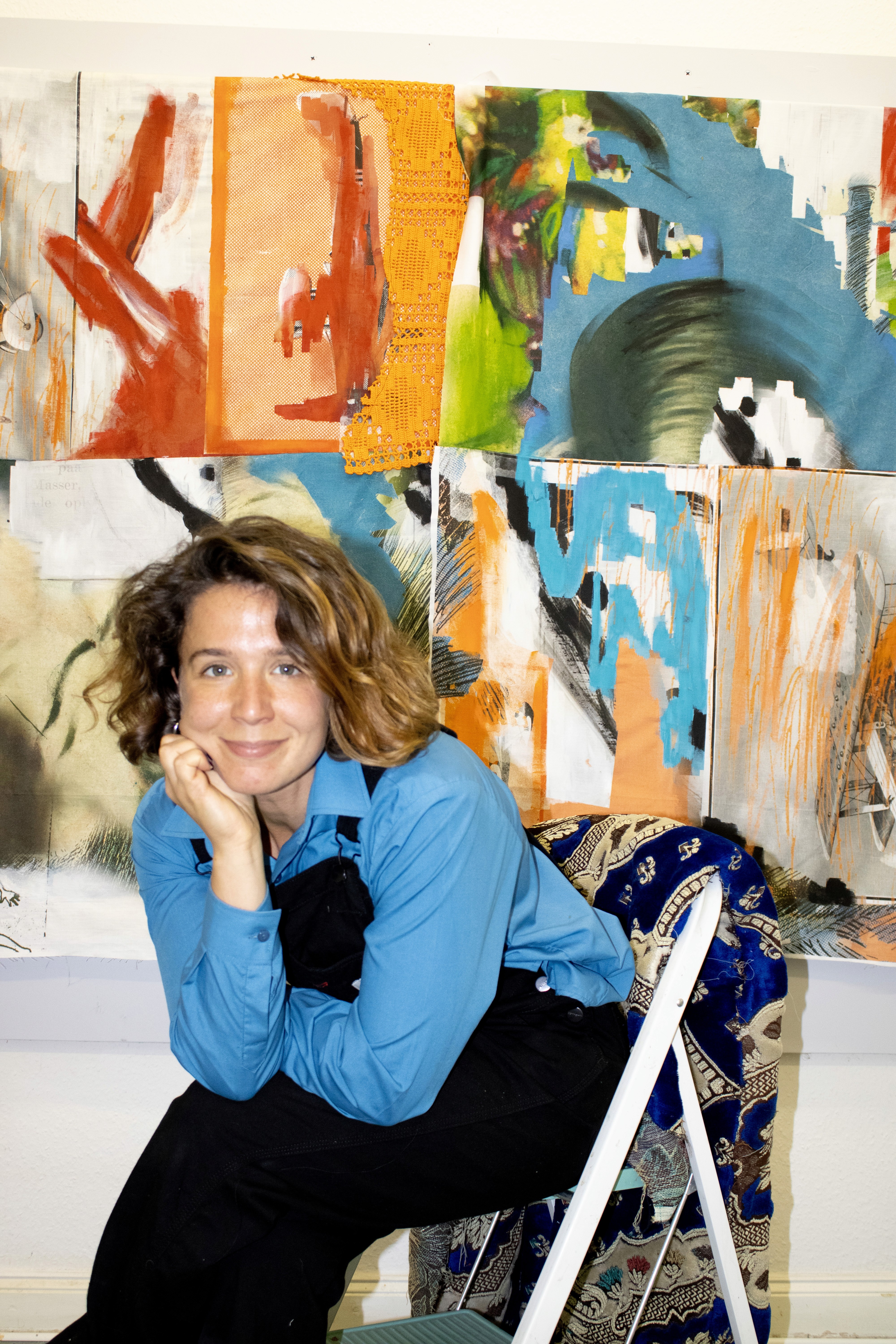
Italian designer and artist Giulia Siviero is a collector. Fabrics, prints, and objects are all vessels in her eyes, their metaphorical vacuity encapsulating a story for her to reassemble. We sift through her archive of things, collected during her travels, while some treasures were found outside her door. Printed ephemera that has miraculously survived the ages, books, tchotchkes and perhaps her most lauded material of choice: textiles. Working with a loaded material, she understands the weight of each fibre beyond its physical presence. Giulia’s obsession with the tactile and the historical makes her somewhat of a curator, preserving and presenting her findings to us.
We discuss her growing archive, its physical and digital forms, and the reality of balancing commercial and creative pursuits. As an artist whose practice is deeply rooted in a sense of place and memory, her work still succeeds in being nuanced, contemporary and open. Deeply sensitive, driven by the pursuit of cultural exchange and celebrating the provenance of the objects she collects, Siviero creates a pin and string board of objects few would think to connect.
Settling into her corner of the shared studio, I find my perch on an armchair next to a side table with a burning candle. The overhead fluorescent lights are off, the sun has begun its descent, and we lock in. The atmosphere feels method, and we’re running with it.
Mia Butter: If you want to start by introducing your practice, we can go from there?
Giulia Siviero: Sure, but I have to start from the beginning.
MB: Please do!
GS: So I have a degree in graphic design, which was very commercial, but I studied at a fine arts academy. I decided to get my master's degree, also in graphic design, because my parents told me that I wouldn’t find a job in Italy as an artist. I went along with it, but my ultimate goal was to leave Italy, so I did this master's degree, also as a way to leave via the Erasmus programme. Everything changed in that moment, and I became so unhappy doing graphic design; I didn’t want to spend my life doing that. When I went to spend the last year of my degree at the fine arts academy in Lyon, I was still studying design, but they had a more artistic approach. I felt a massive opportunity to explore what I could do with my skills and tools gained from my studies, and how they could be reapplied to art. A new universe opened up to me. That was when I started to do what I do now, which looked very different back then.
The course I was taking in France was for a master’s in editorial design, so we were researching the history of graphic design in France, especially French books and the covers of the ‘Livres de poche’ (pocket books). France has a rich graphic design history, and some iconic posters and book covers. Their design practices have always somehow been connected to painting, and I love it. I was just starting to experiment with design tools as a way to create art, and I began making these digital images that were like experimental posters. I started printing them on paper and then on fabric, starting small and then going big, noticing how these images were changing when I scanned them, printed them, and then painted on top of the print.
The source materials that I used were found at antique bookshops, and since I was travelling across France a lot, I found little treasures everywhere. I began to notice how different the materials were, but also found similarities between them, and that was super appealing to me. The fact that I was able to bring things together that would have never met if it weren’t for me was so cool. This came from 1950s Germany, and this comes from 1970s Greece; they found each other, and I did that!
MB: I love that you see it like that, it sounds so fresh and gratifying.
GS: Yeah, that kept things exciting. I kept travelling and going to different flea markets, and at some point, the material that I was finding wasn’t my main interest anymore, but more the fact that I was observing so many cultures. It felt anthropological.
Then I moved to Germany in 2020.
MB: Oof.
GS: I moved here for an internship at an editorial house for arts and culture; it’s very, very small, it’s called The Green Box Books (A-Z presents). I was interning there for six months during the pandemic, and it confirmed that I didn't want to be a graphic designer. I had an identity crisis because I was like, “Am I a designer, an experimental graphic designer, or an artist?” The non-commercial part of the design world is hard because you can gain recognition for cool designs, but at the end of the day, you’re paid really badly. You have to work so much to make any money that you do nothing else, so it’s not even more ‘stable’ than being an artist. I felt in the middle of two things. Once my internship was over, I decided to stay in Berlin and got lucky finding a cheap apartment. I was able to find a job immediately as a graphic designer for a startup, so they had a different mindset that I liked. I could work from home, and I was able to do my tasks in half the time of what was written in my contract, and since it was well paid, I could put that extra time and money into my art. This was how I struck some balance.
In 2023, I was in residency in Lisbon and received a grant from the European Union, so I had a lot of money to put towards my work and experiment with. I started to collect objects as well as printed material that I was using from the start. There is something very appealing to me about objects from the last century. I don't know, I really love the nostalgia, like many people.
Then I had a tough year. Those two months in Lisbon changed me. I usually travelled to Italy or France when I was living there, but this was the first time that I was by myself, doing something completely new. I started surfing in Lisbon, and I felt so alive that doing that, coming back to Berlin and my job, was really, really hard. I decided to take some time off. I also broke up with my partner of many years and started to travel more. I was spending more time in Morocco – I love North Africa, I’ve been going there with my parents since I was a kid.
I was travelling a lot, but I was also researching. Collecting. I was taking analog pictures that I used in my paintings, and I was invited to have an exhibition at a space in Madrid called Tha House, so it gave me something to focus on. Morocco was incredible. I was going to these markets that were overfilled, and very different from what we have here, and I kept seeing these huge umbrellas. They almost can’t be called umbrellas anymore, because they are completely hidden by cloth and textiles that create this huge patchwork. That’s basically what I'm doing in my work. The way they displayed their wares, the smell, the sounds – it was all so fascinating. It’s a full sensory experience. I wanted to recreate that.
MB: Looking at your ‘umbrellas’, I’m brought back to this coastal town in Croatia where my family is from. If your towel is wet or you need more shade, you put your towel on top of the umbrella. In your works, you’re using silk, though, right? Or what material are the draped textiles made of?
Read the full article in printed issue
