Interview
Berlin
It's Billie's World, And We're Just Living In It – In Conversation With Billie Clarken
Issue 01: Community & Network
49.99€
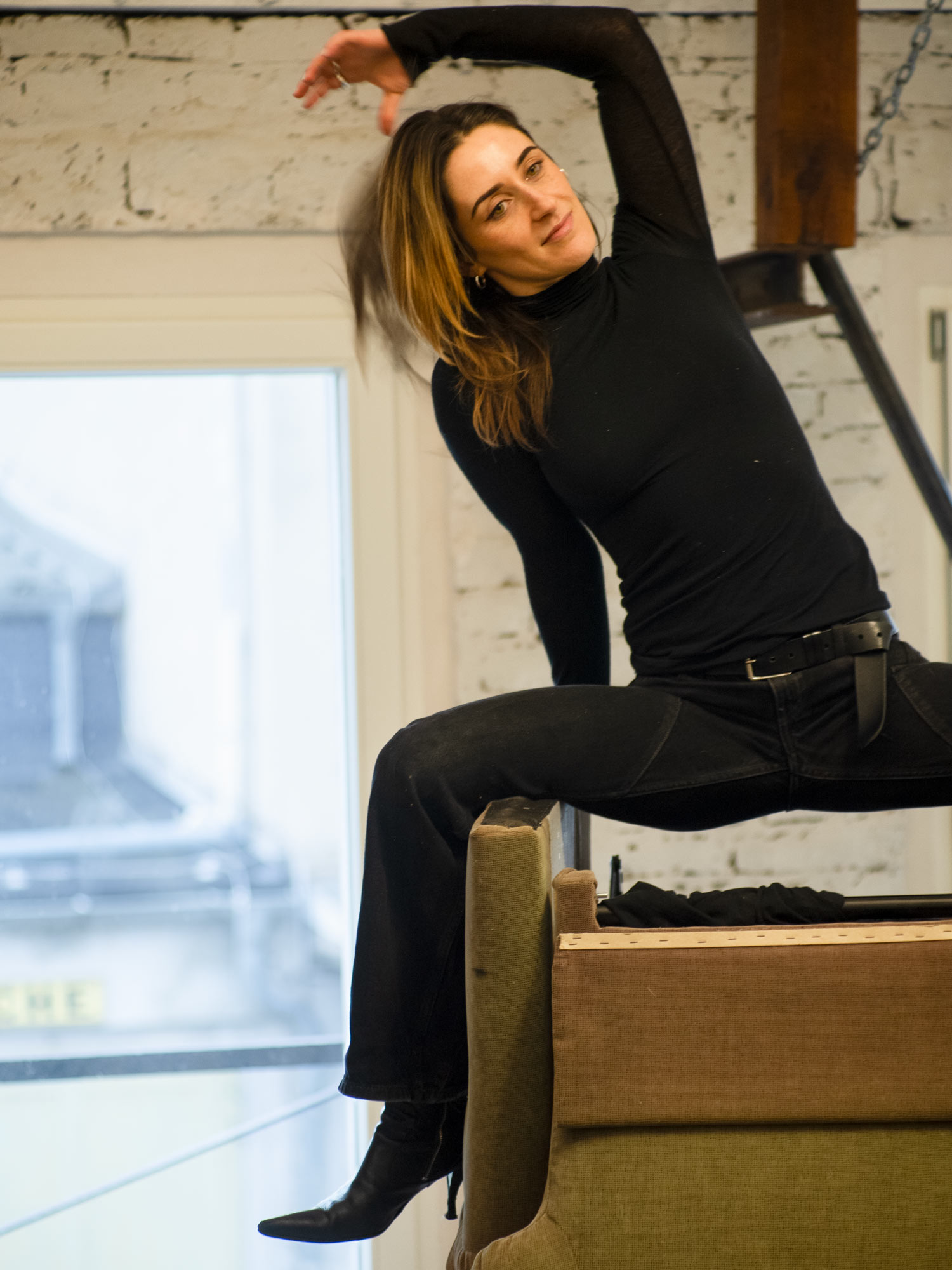
I discovered Billie’s work when I was in high school, shortly before beginning my studies in Fine Arts. I was so desperate to figure out how other artists used such a wide range of materials. Where did they find them? How did they learn how to use them and mould them into artworks? Seeing Billie balance metal rods, foam, taxidermy, furniture, chains, printed mirrors, video art, and more, I was envious, inspired, perplexed, and yearning to figure it out for myself. I asked her, “How did you learn to do this?” when looking at her ‘TNT’ series. “From lots of midwestern moms on YouTube”. Her studio is up a steep flight of stairs, through a shared space, and behind a metal door. It’s simple, organised and yet lived in. Several works are seen stored on a shelf or leaning against a wall. A recliner, flipped on its head, houses a MacBook – a recent work (‘Something to Wash My Eyes’, 2025) that is being optimised, and stands smack in the middle of the space. Once flipped right way around, the viewer is supposed to crawl under the lifted footrest of the recliner to see the film playing on the screen. Currently, the MacBook is held up haphazardly, and the black cloth to block out the light during viewing is an old T-shirt. The craftsmanship is being worked on, even though I appreciate its preliminary form. The neck hole of the T-shirt is quite literally designed for a head to pop out of, and the thick material looks like it would do a fine job at blocking out light. I digress. Billie Clarken is an American multidisciplinary artist based in Berlin, working with objects that reference television culture and projected identity. Speaking with someone as nerdy and obsessed with pop culture as myself was as rewarding as anticipated. We discuss our favourite VHS tapes, North American basement lore, and Abercrombie and Fitch to round things off, and attempt to figure out the parameters for a fun but interesting way to engage with your community. The newsletter sign-up link for ‘Billie’s World’ is active on the surface, but the idea is still brewing in her mind. I can’t promise you a coherent interview, but would you take some train-of-thought rambling?
Mia Butter: So, I signed up for your newsletter last night.
Billie Clarken: I actually made that because I feared that social media was about to collapse. I was like, “I have to be able to reach people again, people that are genuinely interested, so I'm not yelling out into an ether.” So yeah, I created ‘Billie's World’, and I thought I was gonna keep a journal while I was in Mexico City, and then it felt like humble bragging or something, so now I'm working on a new project.
My intern, Paula, is coming back to work for me. I had my first intern last year, and she graduated and got a grant to intern again, so she's helping me work on this new project. I think that I'll start releasing that on ‘Billie's World’… It’s going to be a ‘reader’. I'm really into sociology and philosophy, and I've always applied my research to my art and read visual representations of deeper theories. I think I'll use ‘Billie's World’ to be a Patreon of sorts, but I hate the paywall. In this economy, I don't feel like sharing objects, but I have an excellent eye for curating text and people, so I want to share excerpts from books that I like. I'm actually having Paula scan all of these books and texts, creating a big binder, and then eventually I'll sell it for like 20 bucks or something. I don't know, I didn't grow up with this sort of thing because I was a child of the Internet. So, I was told that back in the day, you used to go to the copy shop and you'd say what class you were in, and then there would be this reader, this master-copy thing, and you'd sit there, and you'd scan every fucking page of what the professor decided was what you needed to read for that semester, and I love that. I am a destructive reader. All my books have lines, a few notes in them, and that's a huge part of my art practice.
MB: Thank God, not enough people do that. Everyone should deface pages with their thoughts.
BC: I know! People are so precious about books. So with ‘Billie's World’, I want people to understand where I'm going, based on evidence, because I genuinely feel like people don't actually know. They might not always get the reference or inside joke. When I was a student at UdK, we were never required to read a specific list of books or essays, but to be fair, I was only in the studio class. So, I'm gonna create this reader to engage in the way I would have wanted, especially during COVID. I would love to interview other artists and people I feel like I could connect with. I want to filter out who really gives a shit, you know? As if it’s a course map designed by me.
MB: I feel you, I’m following that same urge.
BC: There is a raw human instinct to collect objects. It's literally our human nature to create series, which is why we have children or create a physical art practice or something. It's all about legacy building. My aunt collects these very specific teddy bears called Muffy bears. My mom used to collect those Precious Moments porcelain figurines. They're really sad looking… I think I still have one.
I like to collect images. I like to share text. I can't post text without images. My goal with ‘Billie's World’ is, like, maybe once a month, I'd share some text. Or maybe I would share a conversation with someone, like record this and have a sound piece. Now that I'm going more into video art, I feel very nervous about sharing art on social media. I feel it loses context so fast, and I'm afraid that it's either appropriated incorrectly or it's not copyright-friendly. For instance, I don't have anywhere to share my video pieces. I can't post it in a reel, because then you're signing your rights away, so I'm trying to figure out a way to share a diary or something where I sense that I am truly sending a transmission with some sort of direction.
MB: The democratisation of these platforms is not as democratic as we would have hoped for, huh?
BC: That's another thing I’d like to work towards. I want to be a vigilante for the artists who don't write consignment agreements. I mean, I've been almost fucked over so many times, but I know how to write contracts from my photography practice. There are so many people who don't have that, or they don't know how to do that for themselves. I mean, in Berlin, it used to be punk, and you brought your art into a space, and you hung it up, but if someone stole it – that sucks, end of story. But that’s changing now.
We talk about galleries and an art influencer who recently went rogue on Instagram. Receiving backlash from her followers, she responds with a slew of text posts – is this the current model for community building in the arts? Does Instagram really serve any form of community building, besides network ‘maintenance’?
BC: I don't know about the whole difference between network and community, but when I was in art school, my teacher asked us at the beginning of the semester to share what we were good at because we were creating a toolbox, and that was our community network. So, let's say one artist friend of yours is handy, and something in your house breaks, you say, okay, can you fix this? I'll document your artwork in return, and that's what we were working towards creating. We shared resources, second glances, thoughtful critiques. Social media definitely offers that to me; sometimes I think more than others. I could make a post about almost anything, asking for help or recommendations and get so many responses that I started to make a little archive of contacts to save for later or share with others.
MB: What communities are you a part of today?
BC: I would say my biggest community that I'm a part of right now is a WhatsApp group. I don't think it has a name, but I met Hannah on Instagram, and she works for an artist, but also makes clothes. I bought a fabulous top she had been making small batches of for my birthday. It was a giant bow! Later, she added me to this WhatsApp group. People screenshot posts from Instagram stories of jobs and various opportunities in Berlin, and post them in the group. It feels like people are looking out for each other, even if it's an unpaid modelling job, and I like to think we have each other's backs. But that's what Instagram and Facebook used to be. We are 264 members at the moment.
MB: What do you think happened to Facebook?
BC: Oh, Republicans.
MB: Yeah…
Read the full article in printed issue
